Het vormmerk leeft! In België althans… Het Capri Sun stazakje is niet technisch bepaald
 Redactionele bijdrage ingezonden door Marjolein Driessen, Legaltree. Vlak voor kerst (2015) oordeelde de Rechtbank van Koophandel Brussel (IEFbe 1655) over de vermeende inbreuk die door een aantal partijen wordt gemaakt op de vorm van het stazakje van Capri Sun. Die vorm heeft Capri Sun in 1997 ingeschreven als merk in de Benelux via een Internationale Registratie (hier links).
Dit vormmerk is de afgelopen jaren meerdere keren onderwerp geweest van geschil. Bij de Nederlandse rechters haalde Capri Sun tot nu toe bakzeil. Zowel de Haagse rechtbank (zie: IEF 13734) als de Amsterdamse rechtbank (zie: IEF 14511 en IER 2015/46 met lezenswaardige noot van Wouter Pors) oordeelden in 2014 dat het vormmerk technisch bepaald is en daarmee niet geldig. De Brusselse rechtbank gaat daar niet in mee.
Vormmerken hebben het de laatste jaren steeds moeilijker. Bij het Haagse BMM-event op 24 november 2015 hebben de industrie, merkengemachtigden en advocaten uitgebreid gediscussieerd over het bestaansrecht van het vormmerk. De (in mijn ogen betreurenswaardige) conclusie die kan worden getrokken uit de vormmerkjurisprudentie van het Hof van Justitie EU van de afgelopen jaren luidt dat het bijna geen zin meer lijkt te hebben voor bedrijven om de vorm van hun producten of de verpakking als vormmerk te deponeren. In verreweg de meeste gevallen wordt het depot geweigerd en als het toch wordt ingeschreven, kan er geen beroep op worden gedaan omdat een van de drie uitsluitingsgronden van artikel 3 lid 1 onder e van de Merkenrichtlijn (aard van de waar/wezenlijke waarde/technische uitkomst) alsnog van toepassing wordt geacht.
In de Belgische kwestie speelde voor wat betreft de geldigheid van het Capri Sun stazakje als vormmerk vooral een rol de vraag of de vorm noodzakelijk is om een technische uitkomst te verkrijgen (de andere door gedaagden aangevoerde uitsluitingsgrond – wezenlijke waarde – is door de Brusselse rechtbank terecht snel terzijde geschoven zodat ik bespreking van die grond laat voor wat het is). Gedaagden vonden ook nog dat de in artikel 2.1 lid 1 BVIE vereiste grafische voorstelling ontbrak, maar daar gaat de rechtbank niet in mee. De inschrijving van het stazakje zoals hierboven weergegeven toont de volgende wezenlijke eigenschappen die beoordeeld moeten worden:
- Een zakje bestaande uit reflecterend materiaal;
- In een rechthoekige taps toelopende vorm (smal aan onderzijde / breed en spits een bovenzijde);
- Volledig rechte randen;
- Hoogte-/breedteratio van ongeveer 1.5;
- Specifieke bolling (‘buikje’) aan de smallere onderzijde.
De ovale onderzijde van het stazakje blijft – net als de zijkanten en achterzijde – hier buiten beschouwing. De onderzijde is namelijk niet als zodanig in het depot opgenomen en speelt dus geen rol in de beoordeling. Hieruit blijkt nog maar eens dat het erg belangrijk is voor merkhouders dat het depot van hun merken op de juiste wijze gebeurt zodat zij de bescherming kunnen inroepen voor alle wezenlijke kenmerken van de betreffende vorm. Had Capri Sun iets meer aandacht besteed aan het depot zelf, dan had zij wellicht iets eenvoudiger de bescherming als vormmerk kunnen inroepen. Nu moet zij het doen met die ene afbeelding die is gedeponeerd.
De vraag of één van de uitsluitingsgronden voor vormmerken zich voordoet, moet worden beantwoord vóórdat bekeken wordt of het vormmerk onderscheidend vermogen heeft. Als het betreffende teken op basis van de uitsluitingsgronden van artikel 3 lid 1 onder e van de Merkenrichtlijn (vgl.: artikel 2 lid 1 onder 2 BVIE) geweigerd moet worden, kan er geen onderscheidend vermogen zijn verkregen, aldus het Hof van Justitie EU in het recente Kit Kat-arrest (C 215/14). Uit dit arrest volgt ook dat de drie uitsluitingsgronden niet gecombineerd mogen worden; de weigering van het vormmerk kan alleen plaatsvinden als één van de drie uitzonderingsgronden (of allemaal) van toepassing is op het gehele merk.
Als de hiervoor genoemde wezenlijke eigenschappen dus allemaal noodzakelijk zijn om een technisch effect te behalen, is het vormmerk van Capri Sun nietig. Wat de Brusselse rechtbank in de beoordeling hiervan anders (en: beter?) lijkt te doen dan de Haagse en Amsterdamse rechtbank is het scheiden van oorzaak en gevolg:
“(…) vraag of de vormelementen technisch de oorzaak zijn en dus ‘noodzakelijk’ zijn om de (beweerde) technische uitkomsten te verkrijgen. Het volstaat niet, zoals verweersters en de Nederlandse vonnissen doen, om aan te voeren dat alle wezenlijke kenmerken van de vorm een functie (tot gevolg) hebben, men moet ook aantonen dat de technische functie zelf de oorzaak is van die vorm.” (vonnis r.o. 46).
De Brusselse rechtbank verwijst in die zin ook naar het arrest van het Gerecht inzake de Rubik’s kubus (T-450/09, IEF 14409). De zwarte lijnen in de tekening van de kubus vloeien niet voort uit het draaivermogen, waardoor die zwarte lijnen geen technische functie vervullen. Een kubus met een draaimechanisme hoeft immers niet noodzakelijkerwijs zichtbare scheidingslijnen te bevatten.
De Brusselse rechtbank stelt zich – daarbij geholpen door (de advocaten van) Capri Sun – vervolgens de vraag: “zijn de wezenlijke kenmerken van de vorm de oorzaak van het technische resultaat (en werd die vorm daarom gekozen) of heeft een welbepaalde technische functie gewoon een vorm, de litigieuze vorm, maar ook andere mogelijke vormen, tot gevolg? Enkel in het eerste geval speelt de uitsluitingsgrond. In het laatste geval kan het misschien zo zijn dat dat elk wezenlijk vormelement wel een functie heeft, maar impliceert het voorhanden zijn van alternatieven dat de technische uitkomst de vorm niet bepaalt en concurrenten dus niet gehinderd worden in het zoeken naar een technische oplossing.”
Het bestaan van alternatieve vormen lijkt Capri Sun in deze zaak vooral te helpen. Dat is een benadering die breekt met de lijn van de zeer ruime techniekexceptie die het Hof van Justitie EU heeft ingezet met het arrest Philips/Remington van 18 juni 2002 (C-299/99) en die in de recentere rechtspraak van het Hof (Lego/Mega Brands, C-48/09P, IEF 9083 en Hauck/Stokke, C-205/13, IEF 14209) is bevestigd.
Alhoewel de rechtbank overweegt dat het bestaan van alternatieve vormen om tot eenzelfde technisch resultaat te komen niet volstaat om te ontsnappen aan de uitsluitingsgrond, leveren die alternatieve vormen wél een belangrijke indicatie dat een bepaalde vorm niet de oorzaak is voor het behalen van een technische uitkomst en dus niet noodzakelijk, maar enkel het gevolg daarvan (r.o. 48). Er zijn door Capri Sun vele alternatieve verpakkingsvormen getoond, die in het vonnis zijn afgebeeld. Of deze alternatieven ook allemaal naar voren zijn gebracht in de Nederlandse geschillen, is mij niet bekend, maar in elk geval speelden alternatieve verpakkingsvormen daar géén rol (van betekenis), laat staan dat die alternatieven ervoor hebben gezorgd dat het stazakje van Capri Sun wél (vorm)merkenrechtelijke bescherming toekomt. Al die verschillende verpakkingsvormen tonen aan dat de wezenlijke eigenschappen van het Capri Sun stazakje niet (allemaal) noodzakelijk zijn om een technische uitkomst te verkrijgen. “In casu is de vraag niet of de vorm een functie vervult, maar wel of de vorm noodzakelijk (de oorzaak) is om die functie te vervullen. De talrijke alternatieven sluiten dat uit.”, aldus de Brusselse rechtbank (r.o. 48).
Anders dan bijvoorbeeld de Haagse rechter, acht de Brusselse rechter gezien de vele getoonde alternatieven, de rechte randen van het vormmerk een belangrijk niet-functioneel element. Terecht naar mijn mening. Het helpt Riha (één van de gedaagden) daarbij niet dat zij de vorm van stazakjes heeft ingeschreven als vormmerk waarbij die randen niet recht zijn, waarmee Riha naar mening van de rechter bevestigt dat deze randen niet functioneel bepaald zijn. Ook het verweer dat de rechthoekige vorm beter in de hand zou liggen en daarmee functioneel bepaald is, wordt niet gevolgd. Sommige alternatieve stazakjes liggen juist beter in de hand dan de rechthoekige van Capri Sun.
Helaas wordt in het vonnis niet ingegaan op een ander wezenlijk geacht element van de stazakjes, namelijk het reflecterende materiaal. Niet bij de beoordeling van de technische uitsluitingsgrond, noch bij de inbreukvraag. Alhoewel dit materiaal een in beginsel technisch bepaalde eigenschap lijkt te zijn (zo leid ik af uit het Capri Sun-vonnis van de Amsterdamse rechtbank, IEF 14511), omdat de vruchtendrank daardoor beter houdbaar blijft, heeft Capri Sun er bij haar stazakjes die zij verkoopt voor gekozen – en gedaagden in navolging daarvan ook – het materiaal niet volledig te bedrukken, maar de randen vrij te houden. In mijn ogen is dat een van de herkenbare, onderscheidende elementen van de Capri Sun stazakjes in de praktijk. Voor de theoretische inbreukvraag is dat niet direct relevant, maar het Hof van Justitie EU heeft in het Pi-Design/Yoshida-arrest van 16 maart 2014 (C-337/12 P - C-340/12 P, IEF 13616) geoordeeld dat bij de beoordeling of er sprake is van een teken dat slechts uitsluitend bestaat uit de vorm van de waar die noodzakelijk is om een technische uitkomst te verkrijgen, ook het daadwerkelijke gebruik van het geregistreerde (vorm)merk in overweging moet worden genomen.
De bedrukking van de zakjes door gedaagden wordt in onderhavige zaak (ook) niet meegenomen, omdat het gaat om de specifieke vorm van de stazakjes en die vorm als zodanig voldoende onderscheidend is om zelfstandig als herkomstaanduider te fungeren. Bij de inbreukvraag gaat het om een vergelijking tussen de vorm van de volgende stazakjes:
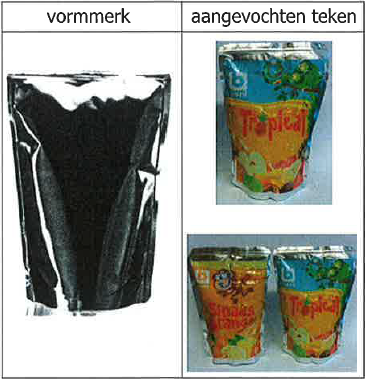
De vorm van de stazakjes van gedaagden wordt door de Brusselse rechter – dus ongeacht de specifieke opdruk – identiek beoordeeld en daarmee inbreukmakend ex artikel 2.20 lid 1a BVIE. Verwarringsgevaar hoeft dus niet te worden aangetoond. Dat komt in eerste instantie wat vreemd over, maar lijkt me toch juist te zijn. Het gaat bij vormmerken immers om de vorm van een product of de verpakking, ongeacht of daar andere (onderscheidende) kenmerken aan zijn toegevoegd. En juist die vorm is identiek. Een andere benadering zou (kunnen) betekenen dat wanneer een gedaagde partij eigen (onderscheidende) elementen, zoals een woordmerk, op de verpakking plaatst, er geen sprake meer zou zijn van inbreuk omdat de consument dan een duidelijk onderscheid kan maken tussen de verpakkingen. Een onbevredigend resultaat (dat – ten onrechte; zie ook de noot van Wouter Pors in IER 2015/46) wel volgt uit de beoordeling door de Amsterdamse rechtbank over de slaafse nabootsingsvordering van Capri Sun).
Al met al een lezenswaardig vonnis op basis waarvan het vormmerk (gelukkig) weer enige rol van betekenis speelt. Of dat zo blijft, moeten we afwachten. Ik acht zeker niet uitgesloten dat gedaagden in hoger beroep zullen gaan van het vonnis van de Brusselse rechtbank. Ook de beide Nederlandse Capri Sun-zaken liggen voor aan de appelrechters. Wordt vervolgd dus.
 Franchiseovereenkomsten. De supermarktketen Jumbo heeft de al jarenlang bestaande franchiserelatie met vier franchisenemer opgezegd vanwege een drietal incidenten. Jumbo beoogt met deze procedure onder meer te bewerkstelligen dat de supermarktexploitaties aan haar worden overgedragen. De franchisenemers betwisten de rechtsgeldigheid van de opzeggingen. Door de incidenten zijn de franchisenemers tekortgeschoten in de nakoming en was Jumbo bevoegd tot opzegging. Ondanks de ernstige gevolgen voor de franchisenemers was opzegging niet onaanvaardbaar.
 Auteursrecht. Beëindiging samenwerking. Eiseres claimt het auteursrecht op diverse plannen en teksten voor websites en dergelijke als vervaardigd ten behoeve van klanten van Interlynx, waaronder strategische communicatieplannen en Marketingstrategie en citymarketing Brielle. Op grond van artikel 8 stelt gedaagde Interlynx dat zij als maker is vermeld, dat zou zijn omdat het bedrijfsbelang dat voorop stelde, zo reageert eiser. Bewijsopdracht met betrekking tot naamsvermelding als maker respectievelijk gestelde overdracht auteursrechten.


